
December 9, 2025

With electricity prices rising across Victoria and more homes switching to solar, many homeowners are now asking the big question: “Should I add a...
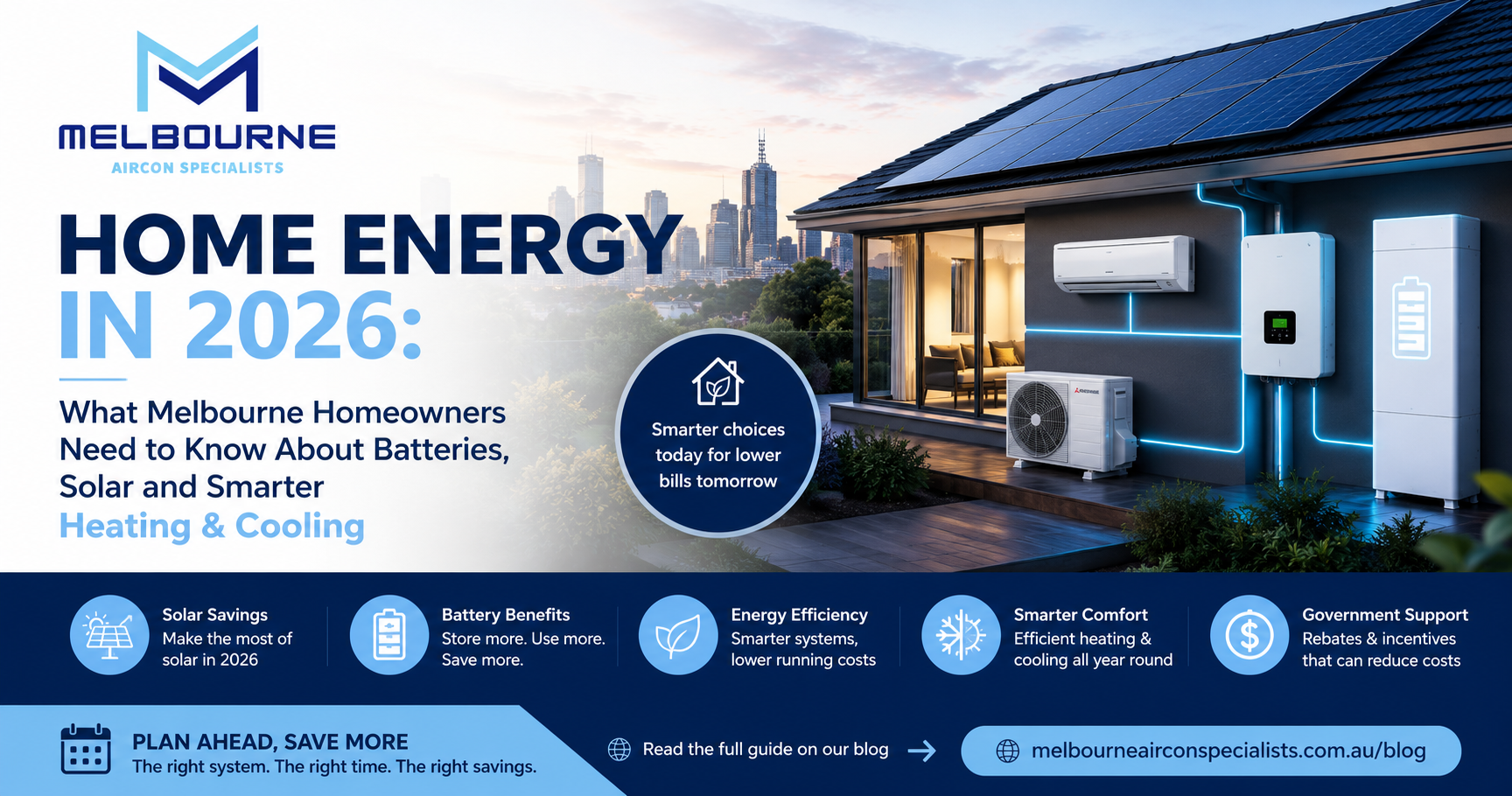
2026 has already been a big year for home energy in Australia. The federal government’s battery rebate scheme has gone through its first major revision, Victoria’s push toward Virtual Power Plants is picking up real momentum, and there’s more choice than ever in both solar and reverse cycle equipment. If you’ve been putting off decisions on any of this while waiting for things to settle, here’s where things actually stand — and what’s worth acting on now.
The federal Cheaper Home Batteries Program has been the main driver of battery uptake since it launched in mid-2025, and it’s still running — but not on the same terms it started with. As of 1 May 2026, the government confirmed changes to the program: the underlying rebate value now steps down every six months rather than adjusting annually, though the core eligibility rules haven’t changed. Eligible systems still need to sit between 5kWh and 100kWh of nominal capacity, and the upfront discount — delivered automatically through your installer, not as a rebate you claim later — still works out to roughly 30% off eligible systems.
The practical takeaway: installing earlier in a given six-month window generally locks in a better rebate than waiting, since the value is set at time of installation. If a battery’s been on your radar, this is genuinely a “sooner rather than later” situation rather than something to keep shelving.
This is where a system like the FOX ESS range becomes particularly relevant. We’ve covered how FOX ESS batteries improve whole-home energy efficiency (https://melbourneairconspecialist.com.au/fox-ess-batteries-improve-whole-home-energy-efficiency/) in detail, and for anyone specifically comparing higher-capacity options, our breakdown of the FOX ESS EQ Series battery in Australia (https://melbourneairconspecialist.com.au/discover-the-power-of-the-fox-ess-eq-series-battery-in-australia/) covers what sets that range apart from the more basic entry-level units on the market. If you’re leaning toward a modular setup that can scale with your household’s needs over time, we’ve also put together a dedicated look at FOX ESS EQ4800 battery modules for Melbourne installations (https://melbourneairconspecialist.com.au/fox-ess-eq4800-battery-modules-in-melbourne/).
One eligibility detail that trips a lot of people up: on-grid battery systems now need the technical capability to participate in a Virtual Power Plant to qualify for the federal rebate, even if you don’t actually want to join one straight away. That’s a meaningful shift from how batteries were sold a couple of years ago, and it’s worth understanding properly before you sign off on a system.
We’ve put together a plain-English explainer on your home, the grid, and Virtual Power Plants — what you need to know (https://melbourneairconspecialist.com.au/your-home-the-grid-and-virtual-power-plants-what-you-need-to-know/), because the concept is simpler than it sounds: a VPP essentially links your battery into a coordinated network of home batteries that can support grid stability, and in return you’re typically paid for the energy your system contributes back. It’s not compulsory to actively participate, but VPP-capability is now baked into eligibility, so it pays to understand what you’re opting into.
With so many brands competing for attention right now, it’s easy to focus purely on price and miss the details that actually determine how a system performs over its lifetime. Our guide to the quality parameters of solar panels and solar home batteries (https://melbourneairconspecialist.com.au/quality-parameters-of-solar-panels-and-solar-home-batteries/) covers what actually separates a genuinely good system from one that looks similar on paper but underperforms within a few years — things like cycle life, depth of discharge, and degradation rates that rarely make it into a sales conversation.
Inverters matter just as much as the panels or battery themselves, and there’s more variety here than most people expect. Our breakdown of the types of solar inverters available in Australia (https://melbourneairconspecialist.com.au/types-of-solar-inverters-available-in-australia/) walks through string inverters, microinverters, and hybrid options, and which situations genuinely call for each one.
Panel orientation is another detail that gets glossed over far too often. If you’re planning a new install, our piece on the best solar panel direction in Melbourne — north versus east-west (https://melbourneairconspecialist.com.au/best-solar-panel-direction-in-melbourne-north-vs-east-west/) is worth reading before you finalise a layout, particularly if your roof doesn’t have a straightforward north-facing section to work with.
With Victoria’s bushfire season becoming a longer and more serious consideration each year, home battery safety deserves more attention than it typically gets in installer sales pitches. Our guide on keeping your home battery system safe during bushfire season (https://melbourneairconspecialist.com.au/keep-your-home-battery-system-safe-during-bushfire/) covers practical steps around installation location, clearance, and ventilation that genuinely reduce risk — this is worth reading even if you installed your system years ago, not just at point of purchase.
Heating and cooling efficiency isn’t just about the equipment you buy — a huge amount comes down to how you actually use it day to day. One of the most common questions we get every summer is what temperature setting actually delivers the best balance of comfort and running cost. We’ve answered that directly in our guide to the ideal temperature for reverse cycle systems during a Melbourne summer (https://melbourneairconspecialist.com.au/temperature-for-reverse-cycle-in-melbourne-summer/) — the short version is that every degree below the recommended range meaningfully increases running cost without a proportional increase in comfort, but the full breakdown is worth a read if you want the specifics.
On the flip side, there’s a right way and a wrong way to switch your system back over after winter. Our guide on turning your cooling on after winter (https://melbourneairconspecialist.com.au/turn-on-your-cooling-after-winter/) covers the quick maintenance checks worth doing first — filters in particular tend to get neglected over the colder months and it’s the single biggest factor in a system underperforming when you first switch it back on.
If you’ve ever stared at your remote control wondering what half the icons actually mean, you’re not alone — our list of air conditioner symbols and their meanings (https://melbourneairconspecialist.com.au/list-of-air-conditioner-symbols-and-their-meanings/) is one of the most-read guides on our site for exactly that reason.
If you’re in the market for a new unit, it’s worth reading our rundown of common mistakes to avoid when buying a new air conditioner (https://melbourneairconspecialist.com.au/mistakes-to-avoid-when-buying-a-new-air-conditioner/) before you commit — oversizing and undersizing are still by far the most common and costly errors we see, closely followed by homeowners choosing a unit based on price alone without checking its actual efficiency rating for their specific room size.
Equally important is who actually installs it. Our piece on why choosing the right split system installer in Melbourne matters (https://melbourneairconspecialist.com.au/choosing-the-right-split-system-installer-in-melbourne-matters/) covers the real-world consequences of a poor installation — incorrect refrigerant charging and badly sealed ductwork are two of the most common issues we’re called out to fix on systems installed by unlicensed or inexperienced installers, and both significantly shorten the life of an otherwise good unit.
If you’re still narrowing down which unit to buy, our current picks for the top split system air conditioners available in Melbourne (https://melbourneairconspecialist.com.au/top-split-system-air-conditioners-melbourne/) is a good starting point, covering a range of budgets and home sizes rather than pushing a single “best” option.
Period and older-style Victorian homes present a genuinely different set of challenges than newer builds — solid brick walls, less insulation, and layouts that weren’t designed with ducted systems in mind. If that describes your home, our guide to improving comfort in older Victorian homes with energy-efficient heating and cooling (https://melbourneairconspecialist.com.au/improving-comfort-in-older-homes-in-victoria-with-energy-efficient-heating-cooling/) covers the specific considerations and system types that tend to work best in these properties, rather than a generic new-build approach that doesn’t account for how these homes actually retain and lose heat.
If you’re weighing up multiple upgrades at once, the honest advice is to start with whichever one has the clearest immediate cost — for most households right now, that’s the battery rebate, purely because the value is currently stepping down every six months. From there, solar orientation and inverter choice, and finally heating and cooling efficiency, are all worth tackling in whatever order suits your budget and timeline.
Rebate figures, eligibility rules and program details referenced above reflect the settings current as of mid-2026 under the federal Cheaper Home Batteries Program and Victorian solar guidelines. These programs are subject to ongoing change, so we’d always recommend confirming your specific eligibility with an accredited installer before committing to any system.
With electricity prices rising across Victoria and more homes switching to solar, many homeowners are now asking the big question: “Should I add a...

With electricity prices continuing to rise across Victoria, more homeowners are considering switching to solar to power their appliances—especially energy-hungry systems like air conditioners....
Hot summers, rising power bills and an old, noisy air conditioner that barely keeps up?For many Victorian households, that’s the reality. The good news:...