December 20, 2025

An air conditioner is meant to keep your home comfortable—not quietly drain your wallet. Yet for many Melbourne homeowners, an ageing or inefficient air...

Solar energy is rapidly becoming a preferred choice for Australian households. But installing panels alone isn’t enough—reliable battery storage is essential for maximising your savings, improving energy efficiency, and enjoying uninterrupted power.
To help homeowners make the right choice, here is a complete and easy-to-understand guide to the main types of solar batteries available in Australia and which ones are best suited for homes and businesses.
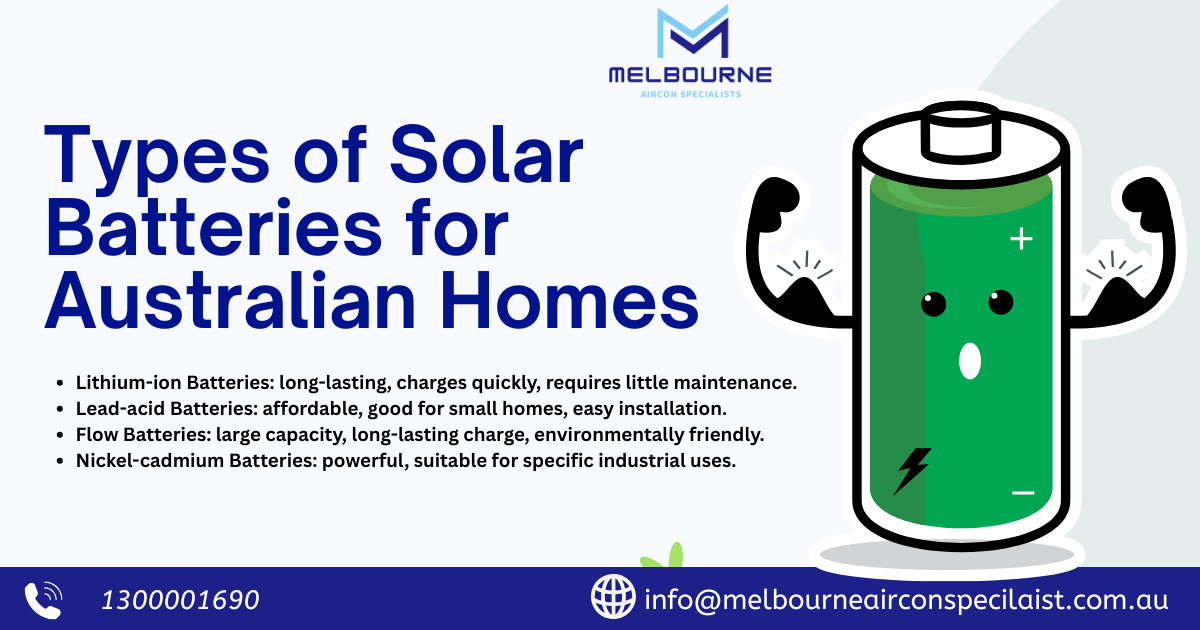
There are four main categories of solar batteries commonly used across Australia:
Each battery type comes with its own strengths, limitations, and pricing differences. Your choice should reflect your energy needs, budget, and long-term sustainability goals.
Lithium-ion batteries are currently the top choice for residential and commercial solar storage.
They offer:
These qualities make lithium-ion solar batteries the most practical option for Melbourne homes looking for high performance and long-term savings.
Lead-acid batteries have been used for decades and remain a cost-effective option for smaller homes or tight budgets. They offer:
However, they have limited storage capacity, shorter lifespan, and are heavier than lithium-ion options—making them suitable mainly for small or backup-only systems.
Pros:
Cons:
Flow batteries are becoming increasingly popular for large-scale or high-demand applications. They deliver:
Although they require more space and have higher upfront costs, they are highly efficient in the long run—especially for large families or commercial operations.
These batteries are extremely durable and fast-charging, but:
For typical Melbourne households, nickel-cadmium batteries are not the most practical option.
When selecting a battery system, consider the following key factors:
🔹 Your daily energy consumption
🔹 Your budget
🔹 Battery lifespan & cycle life
🔹 Installation & maintenance costs
🔹 Environmental impact
Choosing the right battery ensures better energy efficiency, lower running costs, and increased energy independence.
Here are the most trusted brands used in Melbourne homes:
These brands are well suited to both residential and commercial installations.
| Battery Type | Strengths | Limitations | Best For |
|---|---|---|---|
| Lithium-ion | Long-lasting, fast charging, efficient | Higher cost | Homes & businesses |
| Lead-acid | Affordable, easy to install | Short lifespan, heavy | Small homes |
| Flow batteries | Big capacity, eco-friendly, durable | Expensive, bulky | Large homes & commercial |
| Nickel-cadmium | Strong, reliable | Pollution risk, costly | Industrial use |
Because they’re long-lasting, efficient, lightweight, and low maintenance—offering the best performance for Melbourne homes.
Yes. They handle high energy loads, are eco-friendly, and last for decades.
Lithium-ion batteries offer the best lifespan and most charge cycles.
Typically 4–6 hours, depending on system size and sunlight.
Yes, they are low-cost and suitable for limited energy needs.
Around $600–$1,500 per kWh, depending on brand and property requirements.
A well-chosen solar battery can:
✔ Power your home during the night
✔ Protect you from blackouts
✔ Reduce electricity bills by 70% or more
✔ Improve energy independence
Melbourne Aircon Specialist is here to help you select the right solar battery for your property—ensuring long-term performance, efficiency, and savings.
📞 1300001690
🌐 info@melbourneairconspecialist.com.au
An air conditioner is meant to keep your home comfortable—not quietly drain your wallet. Yet for many Melbourne homeowners, an ageing or inefficient air...

With electricity prices continuing to rise across Victoria, more homeowners are considering switching to solar to power their appliances—especially energy-hungry systems like air conditioners....

Running an air conditioner during Melbourne’s hot summers can put serious pressure on your electricity bill—especially during peak afternoon hours when demand is highest....
